Copyright Law in the Music Classroom: What Every Educator Should Know
By Josh Gratton | Popplers Music
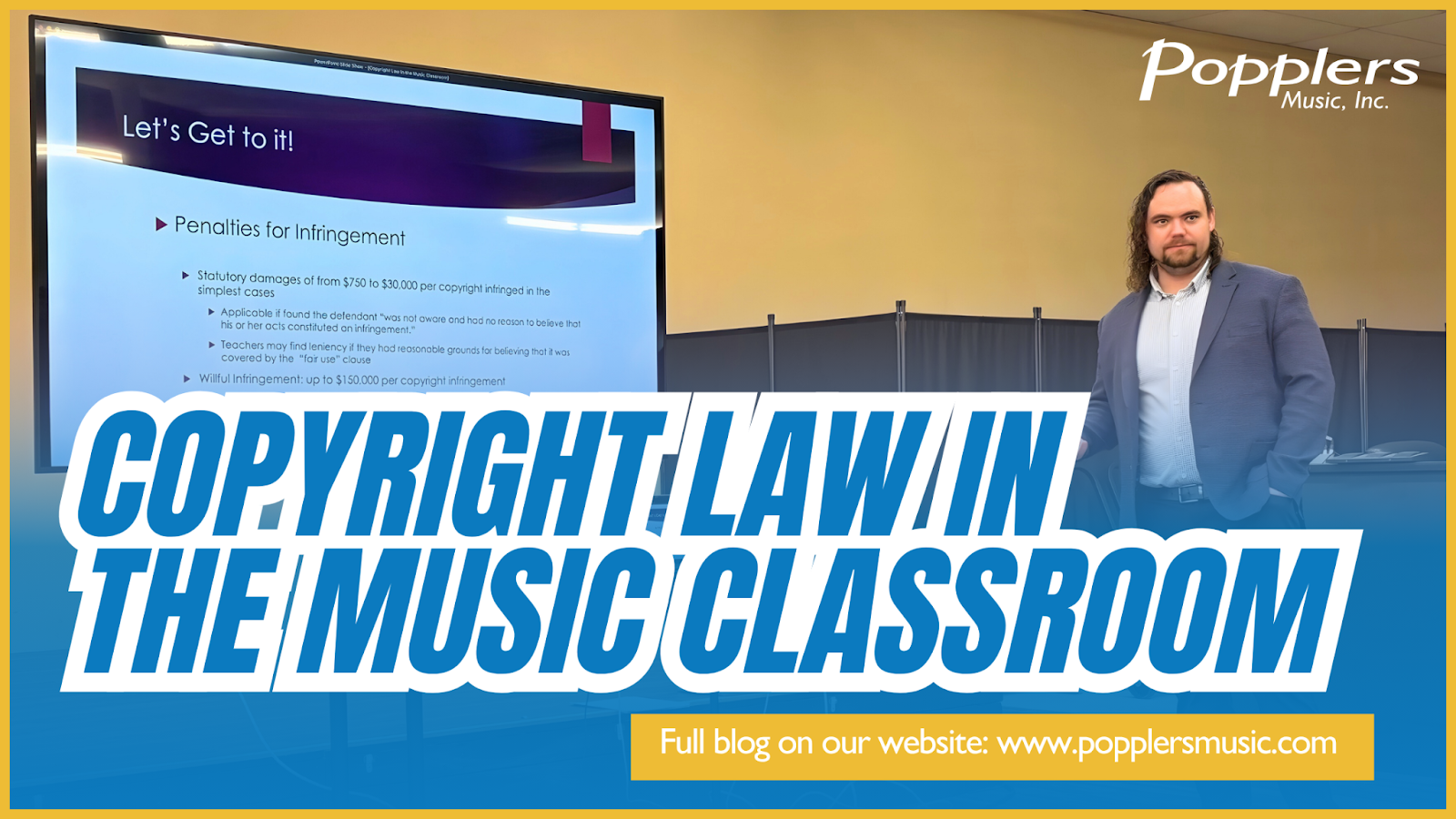
At Popplers Music, we believe that great teaching starts with great understanding and for music educators, that includes knowing how copyright law affects what happens in your classroom, rehearsals, and performances.
Copyright isn’t just a legal formality, it’s a vital part of protecting the creativity that drives our art form. We hope that this guide can help educators navigate the complexities of copyright with confidence, clarity, and care for both their students and the music community.
It’s Not About the Law… It’s About the Application
Copyright law becomes meaningful through how it’s applied. Every teacher, ensemble director, or accompanist makes daily decisions about photocopying music, recording performances, or sharing materials online. These decisions directly affect not only legal compliance but also a culture of respect toward composers and publishers.
The National Federation of State High School Associations (NFHS) now requires teachers and administrators to complete copyright compliance training through their online course, “Understanding Copyright and Compliance.” This initiative ensures that all states follow the same standards of protection and respect for intellectual property.
🎵 Tip from Popplers: Visit NFHS Learn to complete your copyright course and strengthen your classroom practices.
The Basics: What Is Protected Under Copyright?
Copyright protection starts the moment a work is made tangible: written down, recorded, or digitally stored. Before 1978, music wasn’t protected until published, but that’s changed.
It’s important to remember that copyright protects the expression of an idea, not the idea itself. For example, you can’t copyright “a song about rain,” but you can copyright your specific melody, lyrics, and arrangement expressing that idea.
Ownership can be complex. While composers are the original copyright holders, they often sell or license certain rights to publishers or distributors. For instance, Popplers Music carries printed editions from major publishers who hold “print rights,” while composers may retain performance or mechanical rights.
Rights of Copyright Owners
Under U.S. law, copyright owners have five primary rights:
- To reproduce their work in copies or recordings.
- To prepare derivative works (arrangements, adaptations, etc.).
- To distribute copies or recordings to the public.
- To perform the work publicly.
- To perform via digital transmission, such as streaming.
Each right helps ensure the artist maintains control over how their music is used. When you purchase legitimate music through licensed distributors like Popplers Music, you’re helping protect these rights and the sustainability of music creation.
Duration and Transfer of Copyright
Copyright duration depends on who owns the rights:
- Individual composers: 70 years after their death.
- Corporate or “work-for-hire” pieces: 95 years from publication or 120 years from creation, whichever is shorter.
Transfers can take several forms:
- Assignment: transferring partial or all rights (the original holder usually keeps ownership).
- Exclusive License: one entity receives sole usage rights.
- Non-exclusive License: multiple entities can share usage rights.
- Work for Hire: employer owns the work, common in commissioned compositions.
Understanding Licenses
Licenses define how music can be used legally. Here are the main types educators should know:
- Compulsory License: allows performances or covers (for a fee).
- Mechanical License: permits recording and distributing music on CDs, digital downloads, or streaming.
- Synchronization License: required when using music in film, video, or multimedia—this includes teachers recording performances or creating DVDs.
- Permission to Copy: most common in educational settings, for limited, approved copying.
Exemptions in Education
Copyright law does include limited exemptions that protect educators in specific situations.
The “Face-to-Face” Exemption
This allows the performance of copyrighted music in a nonprofit educational institution, provided it’s part of instruction.
It does not apply to:
- Performances outside school (like malls or community events).
- Profit-making institutions (such as private studios).
- School events like assemblies, graduations, or athletic events.
The Emergency Exemption
Educators may temporarily copy a piece for an imminent performance if the purchased music is on order but hasn’t yet arrived. Popplers Music routinely supports directors in these situations to ensure performances continue smoothly while staying compliant.
Fair Use: Understanding the Limits
The Fair Use Clause allows limited use of copyrighted material for educational or scholarly purposes, considering four main factors:
- Purpose and character of the use (educational vs. commercial).
- Nature of the work.
- Amount used relative to the whole.
- Effect on the market value of the work.
Examples of Fair Use
- Quoting short excerpts for criticism or review.
- Including small musical examples in research.
- Creating a parody.
- Recording aural tests or student performances for internal use.
Acceptable Classroom Practices
- Making one copy per student of up to 10% of a piece for study (not performable units).
- Recording classroom performances for private educational use.
- Showing a video or musical excerpt as part of lesson instruction.
Practices to Avoid
- Copying to avoid purchase.
- Reproducing parts for performance (unless under emergency exemption).
- Creating anthologies or compilations.
- Charging students more than the actual cost of legal copies.
- Altering lyrics or arrangements without permission.
Real-World Scenarios: Classroom Examples That Make Copyright Clear
Understanding copyright in theory is one thing—seeing how it applies in the real world is another. Josh Gratton shared several examples that every music educator can relate to, and they clearly show how small choices can make a big difference in compliance.
A common situation involves directors saving a few clean copies of a score while students rehearse from photocopies. Although the intent might be to protect the originals, this practice still counts as copying to avoid purchase, which is a clear violation of copyright law. The better approach is to order extra parts through legitimate channels like Popplers Music, where replacements and additional copies are easy to obtain.
There are, however, many scenarios where copying is allowed. For example, if you have a visually impaired student, enlarging a score or making a single blown-up copy is entirely acceptable. This falls under accessibility accommodations, ensuring that every student has an equal opportunity to participate in music education.
Making a small excerpt copy, up to about 10 percent of a piece, for study or analysis is also acceptable as long as the excerpt does not represent a full performable section. This is a perfect way to teach theory or form without crossing the line into infringement.
Some practices, though, remain firmly on the “do not” list like copying a solo out of a larger collection. For example, taking one movement from a published anthology to use in class is considered infringement because it bypasses the publisher’s intent for that material to be purchased as a whole. Similarly, changing lyrics or creating new arrangements without permission transforms the piece into what’s called a derivative work, which is protected under copyright and requires explicit authorization.
On the positive side, simplifying parts for educational purposes, such as making a line more playable for a beginner, is usually considered acceptable. It’s a practical classroom adaptation that supports learning without changing the fundamental nature of the piece.
Teachers can also record their own accompaniments or backing tracks for rehearsal or internal use, which is a great way to enhance student practice while staying within the limits of fair use. Likewise, transposing a piece for instructional use, say, to suit a student’s vocal range or a particular instrument, is typically fine as long as it’s not distributed or performed publicly without the proper license.
These everyday examples show that copyright law doesn’t exist to restrict creativity but to guide it responsibly. With a little awareness, music educators can continue teaching, performing, and sharing music while modeling ethical and professional practices for their students.
Penalties for Infringement
Violations can lead to statutory damages from $750 to $30,000 per work and up to $150,000 for willful infringement. For commercial gain, penalties can reach $250,000 and up to five years in prison.
While teachers might find leniency if they acted under reasonable “fair use” assumptions, ignorance of the law isn’t a defense. Compliance ensures your program’s integrity and the continued support of music creators.
Trusted Resources
Here are some helpful organizations and contacts mentioned in the presentation:
- ASCAP – www.ascap.com
- BMI – www.bmi.com
- SESAC – www.sesac.com
- Harry Fox Agency – www.harryfox.com
- Music Publishers Association (MPA) – www.mpa.org
- National Association for Music Education (NAfME) – www.nafme.org
- CopyCat Licensing Services – [email protected] (for permissions support)
Final Thoughts: Respect the Craft, Support the Art
Copyright compliance is about more than legality, it’s about honoring the creative process. When you teach students to value original works, you’re instilling respect for the artistry that makes music so meaningful.
Popplers Music has proudly served the music education community across North Dakota and South Dakota for over 100 years. We continue to advocate for teachers, directors, and students by providing legitimate, high-quality sheet music, fast service, and expert support.
🎵 Partner with Popplers Music today. Let’s keep your classroom musical, compliant, and inspiring for generations to come.
📍 Grand Forks, ND – (701) 746-7471
📍 Sioux Falls, SD – (605) 332-6041
🌐 Visit us online: PopplersMusic.com